AI Guide14 min read
Best AI Chatbots in 2026: 8 Models Tested Side by Side
The best AI chatbots in 2026: ChatGPT for range, Claude for writing and code, Gemini for free use. We tested 8 models and checked every price on 25 Nov.
Try it on Merlio:chat with GPT, Claude and Gemini
The best AI chatbot in 2026 depends on what you pay for. On a $20 plan, ChatGPT is the safest all-rounder and Claude is the one we'd pick for writing and code. If you pay nothing, Gemini's free tier is the most generous: Gemini 4 Hydrogen part of the time, plus Deep Research and image generation, at no cost. We ran the same three-part test through eight current models on 25 November 2026 and read every vendor's pricing page that day. Below are the results, the scores behind them, and what each plan actually gets you.
Quick picks (November 2026)
Best all-rounder: ChatGPT Plus ($20/month). Best for writing and coding: Claude Pro ($20/month). Best free plan: Gemini (Deep Research, images, and Gemini 4 Hydrogen part of the time). Best for answers with sources: Perplexity. Best inside Word and Outlook: Microsoft Copilot. Best free option with no paid tier at all: DeepSeek.
The best AI chatbots compared
Prices are monthly in US dollars, read from each vendor's official pricing page on 25 November 2026. "Top score" is the Artificial Analysis Intelligence Index (0 to 100) of the best model on any paid plan, even if that plan caps it or charges extra for it. Where the app runs an older version than the one we track, the score is for the newer API version (GPT-6.2 Astra for ChatGPT).
| Chatbot | Free plan runs | Paid plans | Top model when you pay | Top score | Best for |
|---|---|---|---|---|---|
| ChatGPT | GPT-6 Luna, with limits | Go $8, Plus $20, Pro from $100 | GPT-6 Sol and Astra (Plus) | 62 | Everything, plus the most extras |
| Claude | Sonnet and Haiku | Pro $20 ($17 yearly), Max $100 | Opus, Fable through credits | 65 | Writing, long documents, code |
| Gemini | Auto: Gemini 4 Hydrogen or a lighter model | AI Plus $4.99, AI Pro $19.99, Ultra from $99.99 | Gemini 4 Neon and Carbon (Ultra) | 61 | Free use, Google apps |
| Grok | Limited use | X Plus $8, Premium $30 | Grok models (xAI doesn't say which) | 35 (Grok 4.7) | News and posts on X |
| Microsoft Copilot | Limited, when capacity allows | Microsoft 365 Personal $9.99, Premium $19.99 | Chosen by Microsoft | n/a | Word, Excel, Outlook |
| Perplexity | Basic models, daily limit | Pro $17 (yearly billing) | Model of your choice | n/a | Research with citations |
| Meta AI | Free for everyday use | Meta One Core $7.99, Premium $19.99 | Meta's Muse models | n/a | WhatsApp, Instagram users |
| DeepSeek | DeepSeek V4.1 Flash | None found | DeepSeek V4.1 Flash | 33 | Free, no subscription |
| Mistral Vibe (was Le Chat) | Limited messages | Pro $14.99 | Mistral models | n/a | European option |
"n/a" means the vendor doesn't say which model you get, so there's no single score to give. Copilot, Perplexity and Meta AI route your messages to models they pick.
How we tested
We sent one message with three tasks to eight models on 25 November 2026, each in a fresh chat with its default thinking setting:
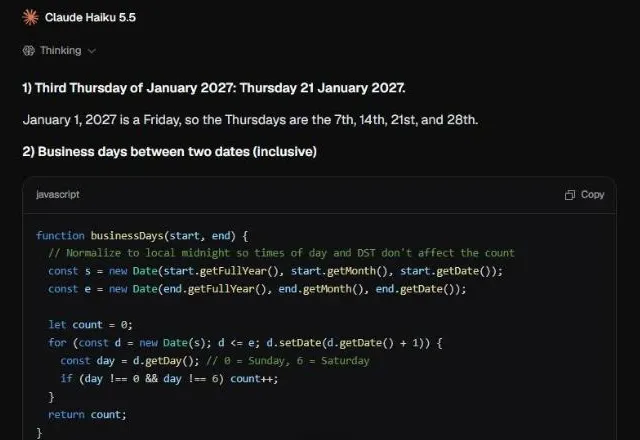
Three quick tasks. 1) Today is Wednesday 25 November 2026. What date is the third Thursday of January 2027? 2) Write a short JavaScript function businessDays(start, end) that counts weekdays (Mon to Fri) between two dates, both inclusive. 3) Write a 3-sentence reply declining a client's meeting invite for Friday: polite, firm, no cliches.
The date question has one right answer (Thursday 21 January 2027) and catches models that guess. The code we ran ourselves in Node.js with four date ranges and six time zones, from Los Angeles to Auckland. The reply is about judgment: does the model follow the brief, or pad it?
A note on who we are. We build Merlio, an app that puts these models side by side, and that's where we ran the tests. So you're seeing the raw models with our settings, not ChatGPT's or Claude's own apps, which add their own instructions and search. Our app has memory too, which shows up below. We stuck to mid-priced and cheap models: the eight answers together cost about 4 cents in provider fees. Each model got one run, so a second try could come out differently. The benchmark numbers come from independent boards (Artificial Analysis, LMArena, Vals AI) as stored on our benchmarks page, read on 18 and 19 November 2026.
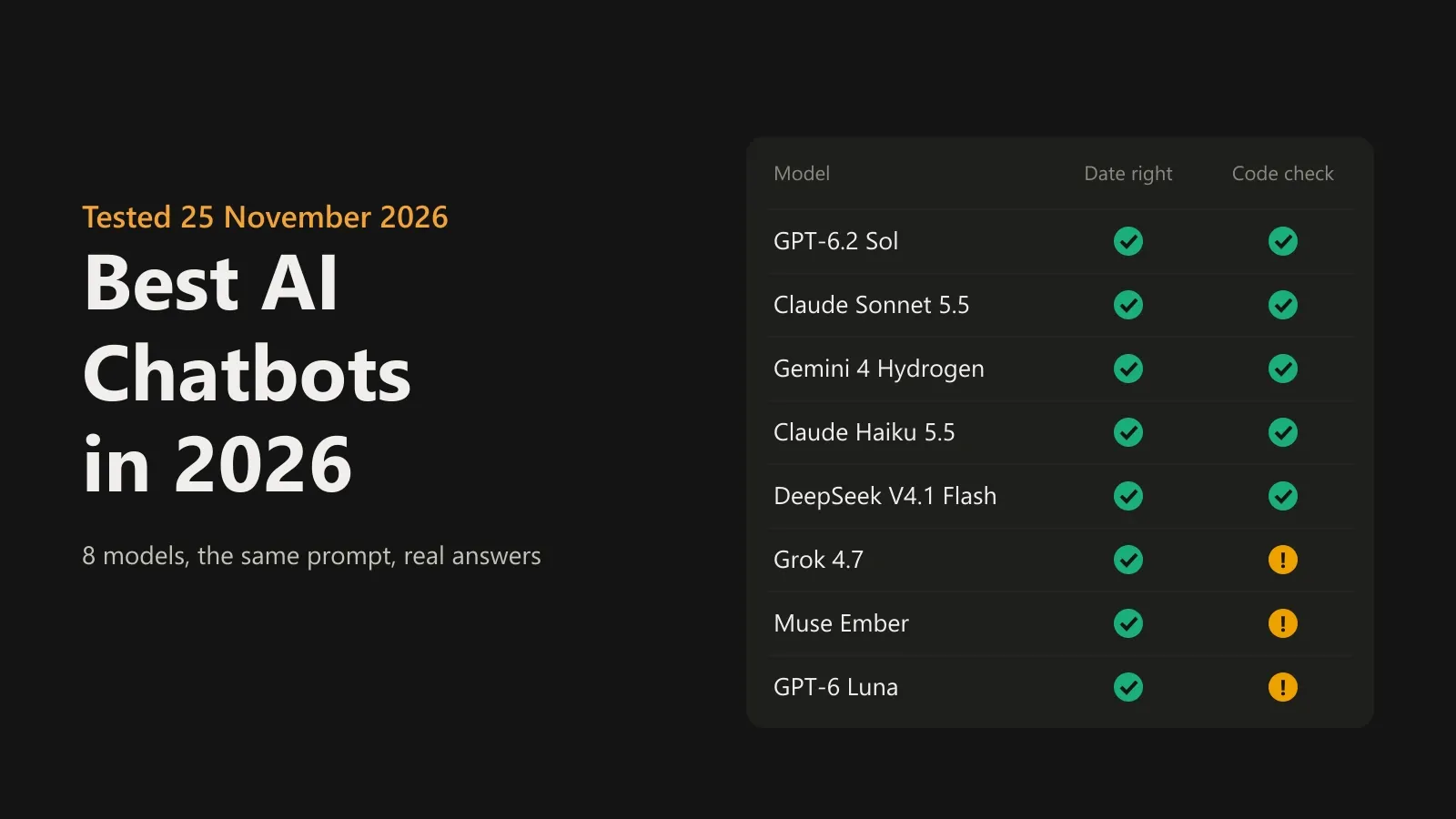
Test results: all 8 got the date right
| Model | Maker | Date (21 Jan 2027) | Code check | Reply | Thinking shown |
|---|---|---|---|---|---|
| GPT-6.2 Sol | OpenAI (ChatGPT Plus lists GPT-6.1 Sol) | Right | Passed, any input | 3 sentences, pushes to email | no |
| Claude Sonnet 5.5 | Anthropic | Right | Passed with Date objects | 3 sentences, asks for new times | 3 s |
| Gemini 4 Hydrogen | Right | Passed with Date objects | Offered "Tuesday or Wednesday morning" on its own | 9 s | |
| Claude Haiku 5.5 | Anthropic | Right | Passed with Date objects | Polite, proposes Monday or Tuesday | 3 s |
| DeepSeek V4.1 Flash | DeepSeek (its app) | Right | Passed, any input | Firm, asks for the agenda | 12 s |
| Grok 4.7 | xAI | Right | Off by a day with date strings in US zones | Shortest and firmest | 8 s |
| Muse Ember | Meta | Right | Off by a day with date strings in US zones | Friendly, a bit long | 1 s |
| GPT-6 Luna | OpenAI (ChatGPT free plan) | Right | Off by a day with date strings in US zones; code block broken | 3 sentences | 1 s |
Nobody failed the date question. Five of them also showed their working (1 January 2027 is a Friday, so the Thursdays fall on the 7th, 14th, 21st and 28th), which is what you want when you can't check the answer yourself.
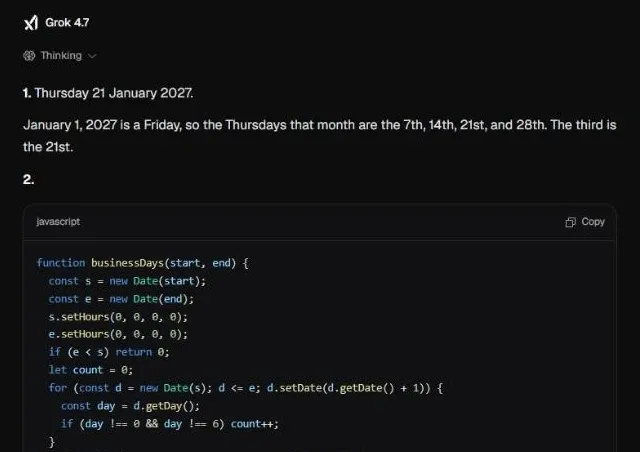
The code is where they split. Grok 4.7, Muse Ember and GPT-6 Luna wrote new Date(start) and then reset the hours in local time. Pass them a string like "2026-11-23" from New York or Los Angeles and the count is off by a day: 4 weekdays instead of 5 for Monday to Friday, 22 instead of 21 for January 2027. In Paris or Tokyo the same code is fine, which is exactly the kind of bug that slips through review. GPT-6.2 Sol and DeepSeek V4.1 Flash worked in UTC and passed in every zone. The two Claude models and Gemini 4 Hydrogen expected Date objects instead of strings and passed when used that way. Claude Haiku even added a worked example and a note on daylight saving time.
The meeting reply showed personality more than skill. Grok wrote the tightest one: "I can't attend that day. Send two or three other times and I'll confirm one." Gemini 4 Hydrogen offered "Tuesday or Wednesday morning next week" and Claude Haiku offered "Monday or Tuesday of next week". Helpful, until you notice neither knows your calendar. Claude Sonnet 5.5 signed off with the tester's first name, picked up from the app's memory. Handy, though it shows how memory leaks into everything you draft.
One prompt isn't a ranking, so the next section leans on public boards built from far more tasks and votes than we could run.
What the benchmarks say about the smartest AI chatbot
The Artificial Analysis Intelligence Index averages coding, science, knowledge and reasoning tests into one score. Here are the models behind the main chatbots, as read on 19 November 2026.
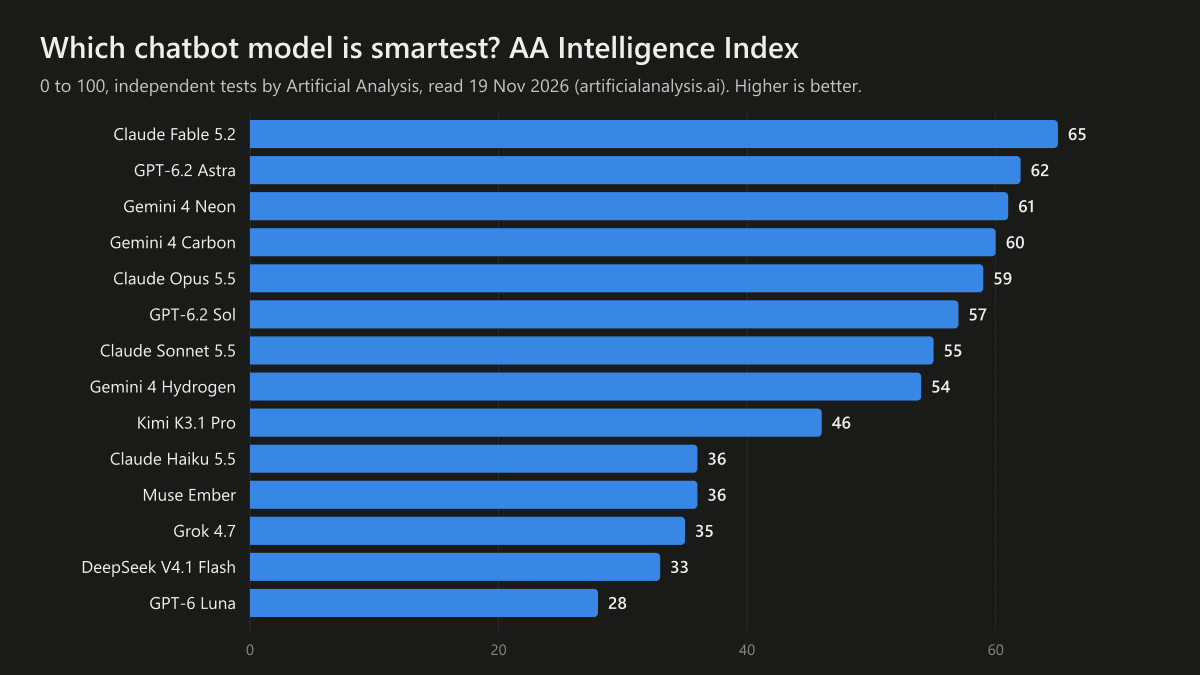
The top is crowded. Claude Fable 5.2 (65), GPT-6.2 Astra (62), Gemini 4 Neon (61), Gemini 4 Carbon (60) and Claude Opus 5.5 (59) sit within six points of each other, so at that level the app around the model matters about as much as the model.
The free tiers are where the real gap is. ChatGPT's free plan runs GPT-6 Luna, which scores 28. Claude's free plan includes Sonnet, whose current version scores 55. Gemini's free plan uses Auto, which sends each prompt to Gemini 4 Hydrogen (54) or a lighter model, according to Google. If you won't pay, that's the number that matters most.
Human votes rank things a little differently. On LMArena, where people pick the better of two anonymous answers, Gemini 4 Carbon was #1 on 18 November with a rating of 1526, ahead of Gemini 4 Neon (1518), Meta's Muse Wonder (1511) and Claude Opus 5.5 (1507).
Price climbs fast near the top. A typical answer (2,000 tokens in, 800 out) costs about $0.0006 on GPT-6 Luna or Claude Haiku 5.5 at list API prices, about $0.012 on Claude Sonnet 5.5 or GPT-6.2 Sol, and about $0.048 on Claude Fable 5.2 or GPT-6.2 Astra.
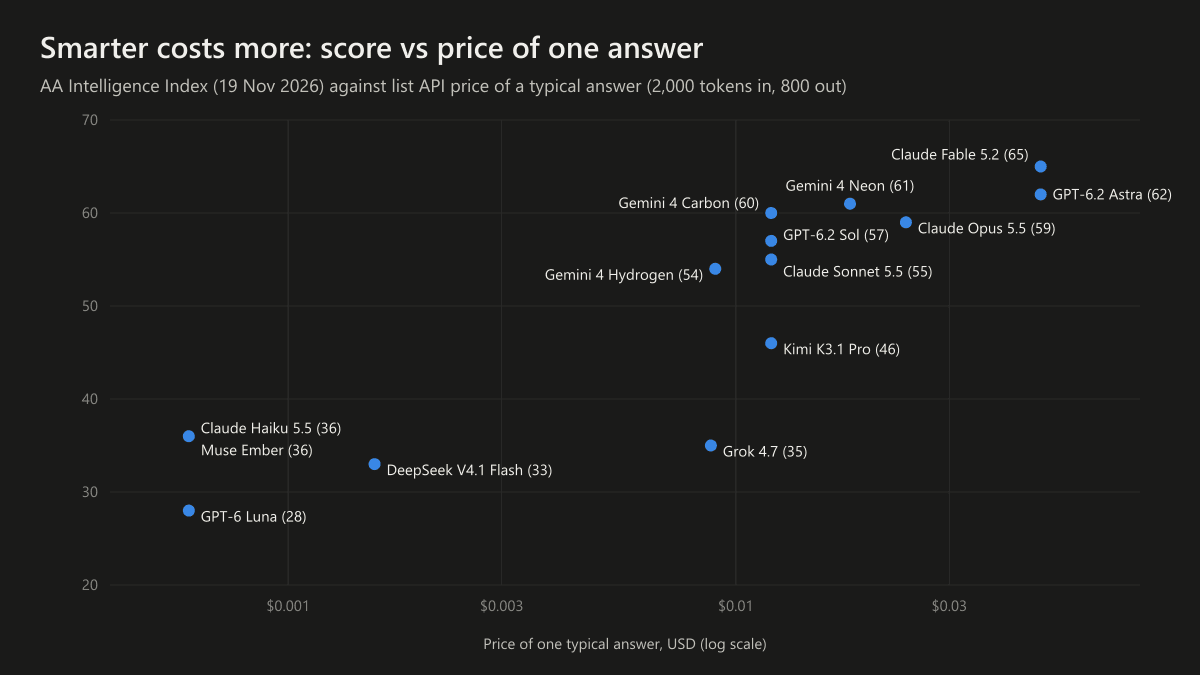
That's why a $20 plan gives you a capped amount of the best model rather than unlimited use. On coding specifically, Vals AI's Terminal-Bench 4.0 (real command-line tasks) has Claude Opus 5.5 and Claude Fable 5.2 tied at 65.15%, Claude Sonnet 5.5 at 64.14% and GPT-6.2 Sol at 60.61%.
The best AI chatbots, one by one
ChatGPT: the best all-rounder
ChatGPT Plus packs the most extras we found: projects, memory, image generation, voice with video, custom GPTs, scheduled tasks and Sites on Plus. Plus costs $20 a month and opens the GPT-6 family, including GPT-6 Astra. In our test we used GPT-6.2 Sol, a newer API version of the Sol model that Plus lists as GPT-6.1 Sol. It and DeepSeek were the only two whose code handled plain date strings in every time zone, and Sol answered without visible thinking.
The weak spot is the free plan. It runs GPT-6 Luna, which scored 28 on the AA index, and its code came back as a broken block in our test. The $8 Go plan raises limits but OpenAI's pricing page says it "may include ads".
Pick it if you want one subscription that does a bit of everything. If you're thinking of leaving it, our guide to ChatGPT alternatives goes further.
Claude: the best for writing and coding
Claude's free plan includes Sonnet and Haiku, and Pro ($20, or $17 a month billed yearly) adds Opus and Claude Code. Fable, Anthropic's newest model, costs extra credits on Pro and is included up to half your weekly limit on the $100 Max plan. Claude Fable 5.2 has the highest AA index we track (65), and Claude models hold the top three Terminal-Bench 4.0 scores among the models here.
Both Claude models in our test wrote careful, commented code, and Haiku added a worked example nobody asked for but everyone needs. Their replies were polite rather than blunt. Limits reset every five hours and every week (Gemini works the same way), so heavy users hit walls.
Pick it if you write long documents or code every day. More on the models: Claude Sonnet 5.5, Claude Opus 5.5, Claude Fable 5.2. Weighing other options? See our Claude alternatives.
Gemini: the best free AI chatbot
Google's free plan includes Deep Research and image generation. Its Auto mode routes each prompt to Gemini 4 Hydrogen or a lighter model, so you get Hydrogen some of the time; Hydrogen scored 54 on the AA index and passed our code check with Date objects. AI Plus ($4.99) lists Hydrogen with double the free limits, AI Pro ($19.99) adds Gemini 4 Neon, and only Ultra (from $99.99) gets Gemini 4 Carbon, the model people rated highest on LMArena.
The catch: like Claude Haiku, Hydrogen offered meeting times you never gave it, so reread before you hit send.
Pick it if you don't want to pay, or you live in Gmail and Google Docs. See Gemini 4 Hydrogen and Gemini 4 Carbon.
Grok: the best for what's happening on X
Grok now comes with the X subscription: Plus at $8 and Premium at $30, according to xAI's docs. Grok 4.7, released in September, scored 35 on the AA index (xAI doesn't say which Grok model the app runs). In our test it wrote the best meeting reply and explained the date step by step, but its code was off by a day with date strings in US time zones.
Pick it if you already pay for X and want answers about posts and news there. Details: Grok 4.7.
Microsoft Copilot: the best inside Office
Most of Copilot's value sits inside Word, Excel, PowerPoint and Outlook, which starts with Microsoft 365 Personal at $9.99. Microsoft picks the model for you; its September blog post says Claude Opus 5.5 and GPT-6 Sol are rolling out to Copilot. The free version runs "subject to available capacity", in Microsoft's words.
It makes the most sense if your work already happens in Office files.
Perplexity: the best for research with sources
Perplexity is built around search and shows its sources next to the answer. Pro costs $17 a month billed yearly on its pricing page and lets you choose the model, plus Deep Research. We didn't test it here, because it answers with search results rather than from the model alone, which would make a side-by-side unfair.
Use it when you need to check where a claim comes from.
Meta AI, DeepSeek and Mistral Vibe
Meta AI is free inside WhatsApp, Instagram and Facebook, and Meta's new Meta One plans ($7.99 and $19.99) add more image and video generation. Meta's API model Muse Ember thought for 1 second in our test, tied with GPT-6 Luna for quickest, and Artificial Analysis clocked it at 468 tokens a second, but its code had the same date-string bug as Grok.
DeepSeek has no paid consumer plan that we could find. Its app moved to DeepSeek V4.1 Flash in October, according to its changelog. It scored 33 on the AA index, thought the longest in our test (12 seconds), and passed the code check in every zone. See DeepSeek V4.1 Flash.
Mistral Vibe is the new name of Le Chat since August (Mistral help center). Pro is $14.99. It's the main European option, but Mistral doesn't say which model the app runs, and the one we track, Mistral Large 4, scores 26 on the AA index.
Which AI chatbot should you use?
- If you pay nothing: Gemini, or Claude's free plan if you write a lot. Claude's free Sonnet scores 55 and Gemini's Hydrogen 54 on the AA index (Gemini uses it part of the time), against 28 for ChatGPT's free model.
- If you'll pay $20: ChatGPT Plus for range, Claude Pro for writing and code. The scores are close; try both free tiers first.
- If you code: Claude. Sonnet 5.5 sits at 64.14% on Terminal-Bench 4.0 at half Opus's API price. Whatever you use, test date and time code in more than one time zone.
- For research: Perplexity, for the citations.
- If you work in Office: Copilot through Microsoft 365.
- If you want several models: an app that holds many of them, so you can ask a second model when the first sounds unsure.
Free vs paid: what $20 a month buys
The jump from free to paid is mostly about limits and the top model, not new tricks. Gemini and Claude both cap free use in five-hour windows plus a weekly limit. ChatGPT's free plan keeps search and projects but limits uploads, images and deep research. What $20 buys at each:
| $20 plan | Best model you get | What changes |
|---|---|---|
| ChatGPT Plus | GPT-6 Astra | More messages, all GPT-6 models, video in voice, Sites |
| Claude Pro | Opus (Fable costs extra) | Opus, Claude Code, Claude in Chrome, higher limits |
| Google AI Pro ($19.99) | Gemini 4 Neon | 4x the free limits, Neon, more storage |
If you only chat a few times a day, the free tiers of Gemini and Claude are enough. Pay when you hit the limit every week, or when you need the top model for work that matters.
Privacy: which chatbots train on your chats?
This differs more than most people think. On ChatGPT's Free, Plus and Pro plans, "data sharing is enabled by default" (OpenAI); you turn it off in Settings, Data controls. Anthropic says it trains on Claude chats only if you choose to allow it in the Model Improvement setting, and incognito chats are never used (Anthropic). Google trains on Gemini chats while the chat history setting is on, and some chats are read by human reviewers and kept up to three years (Google).
Check before you paste
Whatever the policy, don't paste passwords, client data or health records into a consumer chatbot. Look for the training switch in settings on day one, and use temporary or incognito chats for anything sensitive.
Using several AI chatbots without paying for each
No model was best at all three tasks in our test. Grok wrote the best meeting reply but buggy date code; Claude Haiku wrote careful code but a softer reply. Paying for two or three subscriptions to cover that gets expensive fast, which is why multi-model apps exist (we compared several in our Poe alternatives roundup).
That's the problem Merlio is built for. One plan runs GPT, Claude, Gemini, Grok, DeepSeek and others in the same AI chat, with the cheap models included and the top ones paid per answer, so you can ask a second model when the first sounds unsure. You can compare every model's scores on the benchmarks page before you pick.
Frequently asked questions
Which AI chatbot is the best in 2026?
For most people on a $20 plan, ChatGPT Plus is the best all-rounder and Claude Pro is the best for writing and code. On the Artificial Analysis Intelligence Index (19 November 2026), Claude Fable 5.2 leads with 65, and on LMArena's human votes Gemini 4 Carbon was #1 with 1526. No single chatbot won every task in our test.
What is the best free AI chatbot?
Gemini. Its free plan includes Deep Research and image generation, and its Auto mode sends prompts to Gemini 4 Hydrogen (54 on the AA Intelligence Index) or a lighter model. Hydrogen got both the date and the code right in our test. Claude's free plan, which includes Sonnet, is a close second. ChatGPT's free plan runs GPT-6 Luna, which scores 28.
Is Claude better than ChatGPT?
For coding and long writing, the scores favor Claude: Claude Opus 5.5 and Fable 5.2 reach 65.15% on Terminal-Bench 4.0 against 60.61% for GPT-6.2 Sol. ChatGPT has more extras, such as scheduled tasks, Sites and voice with video. Both paid plans cost $20 a month.
Which AI chatbot is best for coding?
Claude. Its models hold the top three Terminal-Bench 4.0 scores among the chatbots we compared, and Sonnet 5.5 (64.14%) costs much less than Opus. In our own test, GPT-6.2 Sol and DeepSeek V4.1 Flash were the only two whose date code worked in every time zone with plain date strings.
Which AI chatbot is the most private?
Of the three big ones, Claude has the strictest written policy: Anthropic says it trains on chats only if you choose to allow it, and never on incognito chats. ChatGPT shares data for training by default until you turn it off in Data controls, and Gemini trains on chats while chat history is on. Use temporary chats for anything sensitive.
Is a paid AI chatbot plan worth it?
Only if you hit the free limits every week or need the top model for serious work. Claude and Gemini reset free usage every five hours, with a weekly cap. Around $20 a month buys the stronger models (GPT-6 Astra, Claude Opus, Gemini 4 Neon) and higher limits, not new basic features.